Museum Icons: The Timeless Vector Collection for Modern Digital Expression
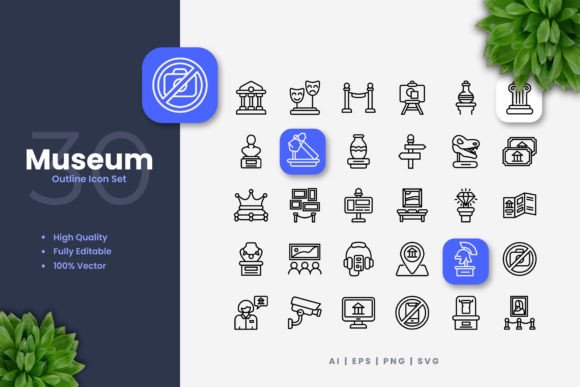
In the fast-paced world of digital design, clarity and efficiency are paramount. Professionals across industries seek tools that not only enhance their creative output but also integrate seamlessly into their workflows. This is where the Museum Icons collection emerges as a pivotal resource. It is a meticulously curated set of 100 vector icons, built on principles of simple and clean icon design, intended to serve as a foundational visual language for a multitude of applications.
The Essence of Simple and Clean Icon Design
Iconography has evolved from mere decorative elements to critical components of communication. In user interfaces, marketing materials, and informational graphics, icons must convey meaning instantly and without ambiguity. The trend towards minimalism in digital design isn't merely aesthetic; it's a response to cognitive load. Users and audiences are inundated with information, and clean, uncluttered icons reduce friction, improving comprehension and engagement. Museum Icons is crafted within this paradigm. Each icon prioritizes geometric purity and legibility, stripping away excessive detail to focus on the core symbolic shape. This approach aligns directly with contemporary standards in UI/UX design, where icon sets like these become the silent guides for user interaction.
Beyond Aesthetics: A Tool for Adaptive Workflows
The true value of Museum Icons lies not just in its visual appeal but in its inherent flexibility. The collection is provided as 100% vector artwork, which means every shape is defined by mathematical points and paths rather than fixed pixels. This is a critical feature for today's multi-platform demands. A marketer might need the same icon resized for a mobile app banner, a social media post, and a printed flyer. With vector source files like the included AI, EPS, and SVG formats, this scaling is lossless and instantaneous. The editable stroke weight is particularly significant, allowing designers to adjust the icon's visual weight to match brand guidelines—from a delicate hairline for a luxury brand to a bold stroke for a tech startup—without redrawing.
Integration with Professional Creative Ecosystems
The design industry's workflow is increasingly software-agnostic, yet deeply reliant on professional vector tools. Mentioning compatibility with software like Adobe Illustrator and CorelDRAW isn't a mere feature list; it speaks to practical integration. These are the environments where professionals live. The "easy drag and drop" capability and the provision of a PNG transparency file for immediate use cater to scenarios where time is limited—a freelancer preparing a client presentation or an entrepreneur prototyping a website. The included Readme.txt file further underscores a commitment to a smooth, professional user experience, reducing setup time and technical hurdles.
Responding to Changing Needs in Content Creation
The audience for Museum Icons—professionals, creators, entrepreneurs, marketers—operates in a landscape where visual content must be produced rapidly, yet maintain high quality. The expectation is no longer to commission custom icons for every project; it's to have a reliable, customizable base library. This collection meets that need. It serves the "design non-designer," empowering a marketing manager to quickly assemble an infographic with cohesive icons, as well as the seasoned graphic artist who needs a starting point for more complex illustration. This duality is essential. It reflects a larger development in creative tools: they must be both accessible for quick tasks and deep enough for expert customization.
The "Museum" Quality: Endurance and Relevance
The nomenclature "Museum Icons" suggests a collection of enduring significance, pieces chosen for their timeless utility rather than fleeting trendiness. In a market saturated with icon packs that follow momentary fads, a set focused on fundamental, clean forms offers sustained value. These icons are unlikely to feel outdated because their design is rooted in universal pictographic principles. This forward-looking, non-speculative quality is key for business and brand assets. A company building its visual identity can incorporate these icons knowing they will remain effective across years of digital evolution, from current website designs to future AR interfaces.
Practical Applications and Observational Insights
Consider a freelance web developer building a site for a small business. Using Museum Icons, they can quickly implement intuitive navigation icons, feature highlights, and footer graphics, all editable to match the client's color scheme directly in Illustrator. A social media manager can use the PNG files to create a series of consistent, professional posts explaining service offerings. An author can incorporate them into an ebook for clean chapter indicators. The common thread in all these examples is consistency and speed. The collection acts as a single source, eliminating the hunt for disparate icons from different sets with conflicting styles, which often undermines project cohesion.
SEO and Helpful Content: Serving the Practitioner's Query
An article about Museum Icons must serve the reader searching for a solution, not just a product. By discussing the broader trends of minimalism, vector flexibility, and workflow integration, the content addresses the "why" behind the search. A professional looking for "editable vector icons for branding" finds here the contextual explanation of why editable strokes matter for brand adaptation. The natural mention of the collection's name within these insights fulfills SEO needs without resorting to keyword stuffing. The semantic terminology—"vector software," "customizable," "drag and drop"—mirrors the language used by the audience in their professional considerations and decision-making processes.
Conclusion: A Foundation for Digital Communication
Museum Icons represents more than a set of 100 drawings. It is a response to the convergent demands of modern digital creation: the need for speed, the requirement for scalability, the imperative of consistency, and the desire for clean, effective communication. By providing a high-quality, fully customizable vector foundation, it empowers a wide spectrum of creators to elevate their visual content across websites, mobile apps, print media, and beyond. In doing so, it connects to the larger, ongoing development of design resources that are both powerful and practical, helping professionals not just to create, but to communicate clearly in an increasingly visual world.